

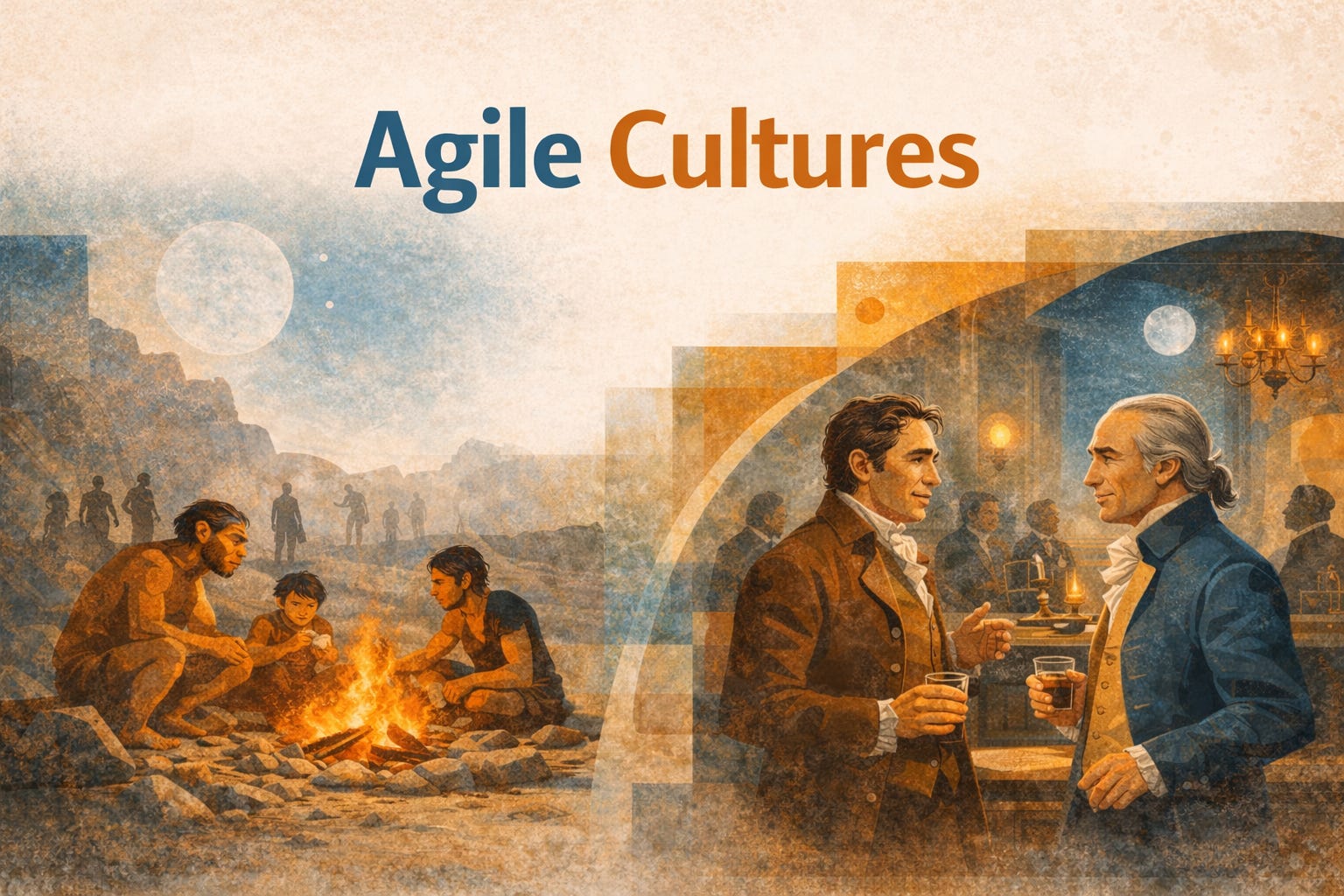
I graduated with a degree in mechanical engineering some years ago. My studies covered historical figures like James Watt, who helped to reshape the modern world. His story is a good introduction to this post on Agile Cultures.
Watt was slight, frequently ill, socially awkward, and prone to depression. In 1772 he inherited the debt of his partner John Roebuck after their steam engine venture collapsed. Years earlier, while repairing a model engine at the University of Glasgow, Watt had recognized a major inefficiency in the Newcomen engine design and developed the separate condenser to solve it. Watt’s great insight was the basis for his venture with Roebuck.
But as many of us painfully learn, good insight is not the same as business success. Watt’s engines were expensive and hard to build. Manufacturing lacked consistency, and investors hesitated.
Matthew Boulton saw something different. He was an accomplished manufacturer at the Soho Manufactory in Birmingham, and Boulton understood organization and scale. He met Watt at a meeting of the Lunar Society, an informal club of scientists, industrialists, and thinkers. Recognizing what the engine could become, he acquired Roebuck’s share of Watt’s patent. Where Watt saw a better machine, Boulton had the vision of a marvelous future. He saw that steam engines would spread all through a newly-powered world.
Under Boulton’s leadership, production stabilized, installations expanded, and financing improved. Steam power shifted to an industrial foundation. Mines drained faster, mills ran more reliably, and power was no longer tied exclusively to rivers or muscle. Within a generation, the improved steam engine spread across Britain and beyond, helping to drive the Industrial Revolution.
Watt’s name remains with us each time we purchase a light bulb measured in watts, a quiet reminder of his work.
Steam engines existed before Watt. Mechanical knowledge was not new. What changed was vision—the ability to imagine a transformed future and reorganize people and effort around it.
But that ability to envision future possibilities did not begin in Birmingham. It began long ago, and is part of a different story.
Deep Origins
The period of human history that best highlights cultural agility is sometimes called the great Out-of-Africa Expansion.
Between roughly 90,000 and 12,000 years ago, Homo sapiens expanded from East Africa across the Middle East, into Eurasia, Australia, and eventually the Americas.
This series of migrations unfolded across many challenges. Our ancestors encountered new animals and plants, extreme climates, deserts, tundras, swamps, jungles, land and water barriers, and other hominin populations.
We interbred with human cousins such as Neanderthals and Denisovans. We acquired new genes and adaptations. And we very likely acquired new cultural tools and some language elements from these cousin groups.
Ancient DNA research shows that human migrations and genetic admixtures have been continuous, at least from 75,000 years ago, and most likely from well before.
We see clear evidence of cultural admixture as well. Hunters became fishers along coasts. Stone toolmakers adapted to bone and antler. Artisans used new pigments, ornaments, totems, and visibly expressed beliefs. Clothing was tailored for cold or hot climates. Nets, needles, lamps, and storage pits appeared. Notched bones and symbolic markings preserved memory across seasons.
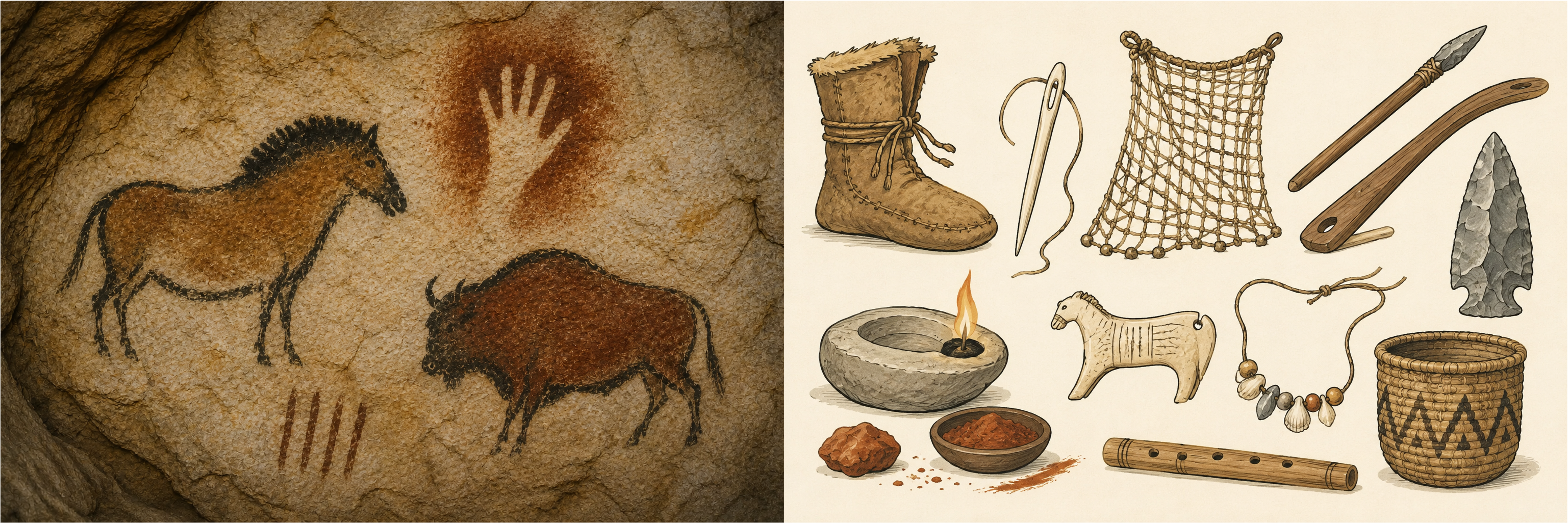
There is evidence of longer-term planning—anticipating and preparing for winter, spring floods, and animal migrations. Humans adapted to new foods and preparations. They buried their dead with grave goods to prepare for the unseen afterlife.
Research suggests that diasporic Homo Sapiens could imagine opportunities well beyond the visible horizon. By diasporic Homo sapiens, I simply mean the expanding populations that dispersed across multiple continents during the Out-of-Africa Expansion.
Biological Foundations
Why did the out-of-Africa migrations succeed? How did our ancestors quite suddenly displace all other hominin populations, despite their own adaptations to climates and regions?
I do not believe there is a single adaptation, cultural or genetic, that was the source of such expansion. There is no particular weapon, or language, or use of fire.
There is, however, good evidence of a tipping point, from the accumulation of key adaptations. I believe these adaptations gave us cultural agility.
Our brain systems became more developed and more coordinated to support clear episodic memory, emotional integration, and improved social cognition.
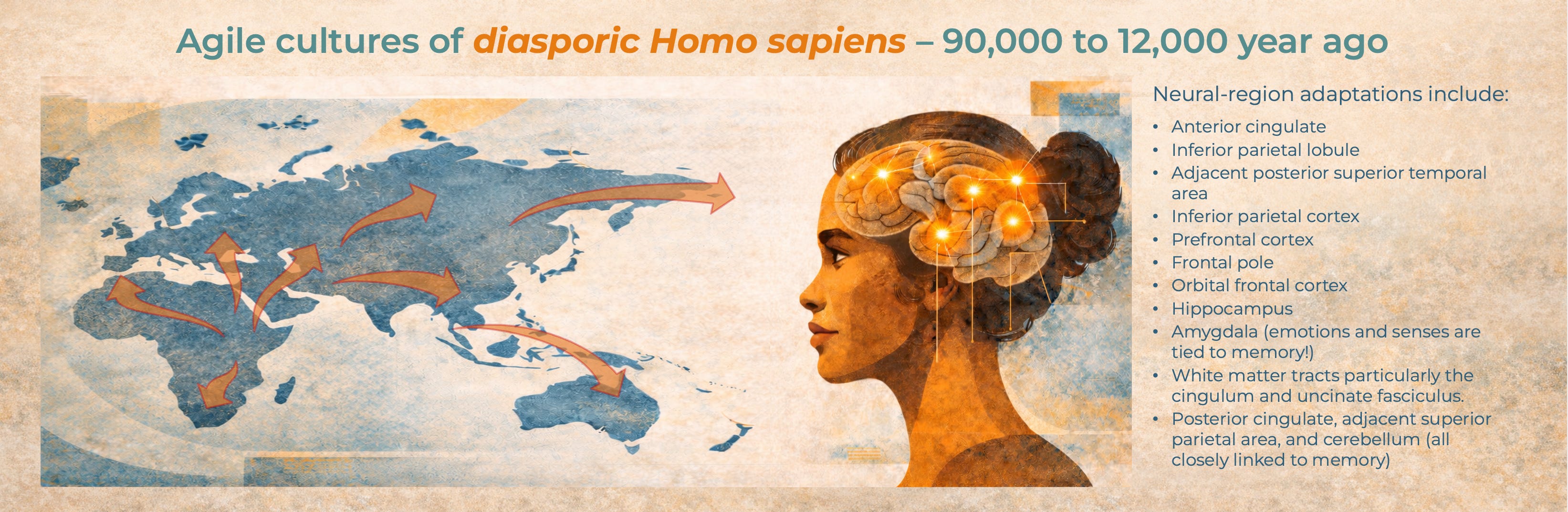
Humans demonstrated stronger recall of past experience and greater ability to project possible futures. Symbolic thought expanded. Childhood lengthened, allowing extended learning and social development.
Interestingly, overall brain size declined slightly after about 35,000 years ago while neural efficiency improved. This may suggest that the integration of thought mattered more than sheer cranial volume.
Biology alone did not cause expansion, but it supported the cultural flexibility, foresight, and group cohesion that quite literally changed our human world.
Core Behaviors of Agile Cultures
Four behaviors are evidenced by diasporic Homo sapiens during this period of roughly 90,000 to 12,000 years ago.
First, shared visions unified group effort. The controlled use of fire had earlier opened up the night to our human ancestors. There is good evidence they gathered in the firelight each evening. Increasingly rich language, arts, and symbols were used to tell stories of the past and envision a better future.
Second, our planning now extended well beyond immediate needs, anticipating longer seasonal cycles, periodic animal migrations, and advance preparation of tools and materials.
Third, the roles within a group became more specialized and flexible to fit with new ecologies and conditions. Human cultures could adapt to adverse conditions more quickly than human biology.
Fourth, curiosity and abstract thinking drove exploration into new ideas, new places, and new tools. Improved episodic memory preserved the lessons of success and failure, and accelerated our cultural adaptation to diverse places around the world.
Each behavior built on the accumulated biological adaptations of diasporic Homo sapiens.
The Foundation Layers
Agile cultures did not arise in isolation. As described by the Working Origins timeline, they were built on earlier layers of emotions and drives, social learning, trust and trade, instruction and iconic language, myth and mediation.
By 90,000 years ago, Homo sapiens already had these core foundations.

What emerged during this period was a better integration of memory, foresight, language, and social cooperation. As mentioned, improved memory and foresight aligned with cultural practices of exploration, planning, and shared meaning. This allowed flexible and agile communities to cross ecological barriers, carrying human presence across the globe.
Agile cultures led to the rise of Techne, or material intelligence, during the Neolithic period starting 12,000 years ago. Techne is the next marker in the Working Origins timeline, describing the domestication of plants and animals, and an associated burst of crafts and skills.
In the Modern Workplace
Seen in this light, Watt and Boulton were expressing ancient patterns of agile organizations. Watt explored, experimented, and refined solutions through careful planning. Boulton acted in a different role. He brought manufacturing discipline, financial structure, and networks, but most importantly he had the vision of a new world.
Shared trust, language, and vision helped smooth over points of friction, guide the progress, and scale up to real growth.
Modern organizations often resemble Watt before Boulton. Skilled people, functioning systems, and genuine innovation are present. Curiosity exists. Planning occurs. Experience accumulates. What may be missing is alignment around a credible future.
Agile cultures emerge when exploration, role clarity, and planning are coordinated by a shared vision of a better way.
Takeaways
Four lessons from agile cultures apply directly to modern business teams.
Build a shared vision. Recognize the power behind a team driving to a better future. The vision may come from within or outside of the group. Share and craft the vision to help unify your team. Listen and observe, and harmonize with feedback. Most visions are not a good fit until a trial-and-error process makes them so.
Plan for new tools. These may include processes, roles, materials, or training. New business often means a new business tool culture.
Act in new roles. Team members must prepare for new roles, as needed. This can represent difficult change management and is often a leadership challenge.
Value diversity of experience. Along any new path, diverse challenges come from the new places, people, or cultures we encounter. These challenges become strengths as we experience and fit around them. This is how we build resilience. Think of our ancestors migrating to all parts of the world. This is a pattern for how human teams adapt.
Cultural agility is not new to us. It is one of our oldest strengths.
Take hopeful comfort in the Working Origins motto: Working together well is the most human thing we ever do.
For more information on this post, see the Working Origins Library and these recommendations…
The Evolution of Paleolithic Technologies by Steven L. Kuhn (2021) — for how shifting tools and techniques reflect adaptable human behavior across changing environments.
Neanderthal Man by Svante Pääbo (2014) — for insight into our interaction with Neanderthals and what genetics reveals about shared histories.
Who We Are and How We Got Here by David Reich (2018) — for a clear account of human migrations and population mixing revealed through ancient DNA.
Origin: A Genetic History of the Americas by Jennifer Raff (2022) — for the peopling of the Americas, cultural exchange, and the long arc of migration into new worlds.