

Hidden by the tall reeds and rushes, the young woman waded along the banks of the Euphrates as it passed by the city of Kish, some 4300 years ago. She carried her baby son in a basket woven from these very same reeds.
As the lowest of servants in a house of priests, she knew enough to hide him from curious eyes.
Found among thousands of cuneiform clay tablets from the ruins of ancient Nineveh, here is the chronicle of these events—in the voice of Sargon the Great:
My mother was a changeling, my father I knew not,
The brother of my father loved the hills,
My home was in the highlands, where the herbs grow.
My mother conceived me in secret, she gave birth to me in concealment.
She set me in a basket of rushes, she sealed the lid with tar.
She cast me into the river, but it did not rise over me,
The water carried me to Akki, the drawer of water,
He lifted me out as he dipped his jar into the river,
He took me as his son, he raised me,
He made me his gardener.
This is the birth story of Sargon of Akkad, preserved in the ancient Library of Ashurbanipal.
Sargon would become one of history's first great empire builders. Step by step, he learned the practices that make civilization work. Sargon would go on to unify the Sumerian city-states under a single authority, establish one of the world’s first empires, and create enduring models of centralized administration, military organization, and cross-regional governance that shaped Mesopotamian civilization for generations.
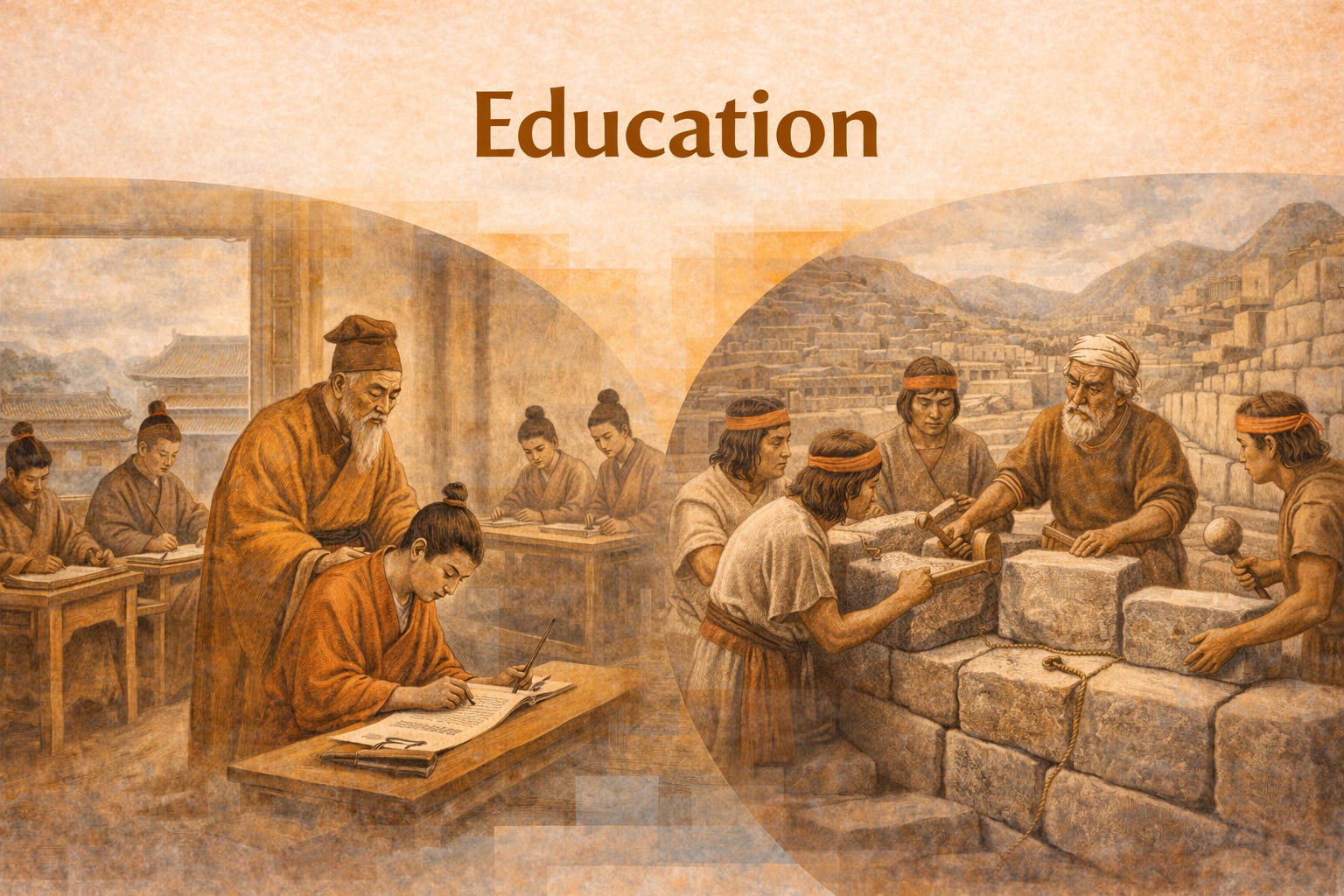
Sargon shows how education—in the broadest sense—serves as the final Working Origins marker.
He rose from gardener to court official, to the king’s cupbearer, and ultimately to ruler of Akkad and Sumer. Along the way, he would have been trained—formally or not—in the core systems of surplus that sustained early civilization.
A surplus is simply more than immediate survival requires. Grain stored after harvest. Extra pottery. Preserved meat. Once societies could reliably store surplus, they could support craftsmen, traders, soldiers, priests, teachers, administrators, and rulers.
Sargon mastered how communities can be turned into civilizations.
He learned the agricultural practices of irrigation, crop cycles and yields, labor coordination for planting and harvest, and how to provision households and temples.
Sargon understood cuneiform scripts, the administrative language of Sumerian, and the Akkadian spoken by the broader population.
He mastered the complexity of trading routes and goods. He knew grain, beer, and oil needed standardized weights and measures, with proper tracking of obligations and deliveries. Sargon established long-distance trade networks to Anatolia in the west and the Indus Valley to the east. The grain, textiles, metals, and stone that moved along these trade networks provided great wealth to the empire.
His fourth key administrative skill was in the area of military command, supply, weapons, formations, and siege tactics.
Sargon mastered the foundations of civilization.
Deep Origins
Around 5,500 years ago, civilizations began to standardize writing and formalize the education of administrators, elites, and priests. Writing and education allowed civilizations to spread across regions and to last for many generations.
Today, technological and cultural innovations constantly reshape how we connect, entertain, shop, travel, eat, and work.
Education, both formal and informal, allows us to keep pace with this rapid change.
Biological Foundations
Today’s cultures are changing at an incredible pace. By comparison, our human biology may appear to adapt more slowly or not at all.
However, human evolution did not stop with the first civilizations. Geneticists remind us that humans continue to evolve. As societies become larger, more interconnected, and more technologically complex, the traits that contribute to success may also change over generations. While the details remain an active area of research, continued biological adaptation is an expected consequence of changing environments and cultures.
Core Behaviors
As civilizations continue to form, our core behaviors adapt and extend well beyond immediate relationships and outcomes.
Training and learning are increasingly mediated by written or video-based instruction. Skills are transferred across time and distance. People learn a narrow and abstract part of a process that is not seen end to end.
Specialized roles. Individuals work in specific roles such as craftsman, farmer, civil servant, educator, or administrator. This requires discipline and an understanding of your place within the community.
Institutional trust. Civilization introduced a new kind of trust in measurements, records, transactions, and institutions. A tally represents an amount of grain. A seal represents authority. A coin represents value. People increasingly learned to trust symbols as much as the people behind them.
Law of the harvest. Individuals learned to accept delayed returns—planting for future harvest, storing rather than consuming, working now for the promise of future benefit.
These behaviors are part of all civilizations today. They shape how we learn, work, and adapt within modern organizations and communities.
Foundation Layers
Successful education and training are ensured when we are mindful of our human foundations.

E is for Emotions, States, and Drives: Absolutely be motivated by your own needs and wants—for yourself or family. Recognize and value your authentic motivations— ambition, desire, or even the need for a simpler life.
S is for Social Learning: All our best human adaptations start as a team, even when the adaptation is personal. If you are retraining, look to a class or group. If you are learning a new sport, join a team or club. If you are in a formal school, be part of a study group. That is how humans are built.
T is for Trust & Trade: Work and understand the workplace environment. Build trust networks with customers, suppliers, partners, and competitors. These expand access to your own knowledge and opportunity.
I is for Instruction and Iconic Language: Seek sound instruction from trusted sources. Align and share in common workplace language and culture.
M is for Myth & Mediation: Be deliberate in what you choose to believe. Belief is a very powerful human expression, especially when aligned with others.
A is for Agile Cultures: Express your innate human agility, even for small incremental changes. Human agility is best expressed by those groups that have a clear vision of what their future may be.
T is for Techne: Apply yourself to developing a practical craft or skill. Use the time, materials, and knowledge available to you with purpose and growing competence.
E is for Education: Education opens the door to new technologies, new communities, and new opportunities.
Today’s Workplace
One encouraging lesson from history is that every major cultural change creates new opportunities for people willing to learn.
Some of today’s fastest-growing opportunities require surprisingly little time to enter.
Modern skilled trades remain in high demand as our buildings, vehicles, and energy systems become more sophisticated. Electricians, HVAC technicians, plumbers, and solar installers combine practical craftsmanship with increasingly advanced technology. Most enter these careers through apprenticeships or relatively short training programs.
Healthcare is expanding just as rapidly. As populations age, more people choose to remain in their homes rather than move into assisted living. Home health aides, personal care assistants, and community caregivers provide meaningful work that combines practical skills with genuine human connection.
Perhaps the greatest opportunity of all is education itself. Every new technology creates demand for people who can explain it, teach it, and help others apply it. Trainers, instructors, certification specialists, and workplace coaches become the bridge that allows new knowledge to spread throughout society.
Many other growing fields reflect the same pattern:
Platform-based local services
E-commerce fulfillment and logistics
Digital customer support and remote operations
Food service specialization and cultural dining
Experience-based travel and local guiding
The specific occupations will continue to change. What remains constant is that people who continue learning are best prepared to participate in whatever new industries emerge next.
Takeaways
These three takeaways are heartfelt messages to family and friends around the world.
Education has become our way of adapting to cultural change.
From the first cities to today's global economy, our own success depends on learning new tools, new roles, and new ways of working together. The pace has accelerated, but the mechanism is the same. Those who learn fastest are best positioned to gainfully participate.Education is increasingly accessible and informal.
Historically, education was expensive and often limited to schools, apprenticeships, and formal roles. Today access has greatly widened. Training, self-directed learning, and real-time instruction are available to anyone motivated to engage. In many cases, the self-directed paths move faster than formal education.Use the Working Origins model to manage the risk of change.
Change always carries risk and uncertainty. The Working Origins model connects you to our human past and to other people today. You are at your best when you work within a team, develop a trust network, share common instruction and language, are unified in belief, and have a clear vision of what the future may hold.
Education is now key to both personal and business growth in a changing world, and reflects a simple truth at the core of Working Origins:
Working together well is the most human thing we ever do.
For more information on this post, see the Working Origins Library and these recommendations…
The 10,000 Year Explosion (2009) by Gregory Cochran and Henry Harpending — explores how human biological adaptations continue alongside the rise of agriculture and civilization.
A History of the Ancient World (2007) by Susan Wise Bauer — a broad and accessible narrative of early civilizations, including a terrific story of Sargon. It is complemented by her lecture-style podcast series on the ancient world.
By Steppe, Desert, and Ocean (2015) by Barry Cunliffe — examines how geography and movement shaped early human networks and cultural exchange.
Code Breaker (2021) by Walter Isaacson — recounts how Jennifer Doudna and others discovered accurate gene-editing processes and then built machines to do so at scale.
1491: New Revelations of the Americas Before Columbus (2005) by Charles C. Mann — reframes pre-Columbian societies as complex, populous, and highly organized.
Forgotten Peoples of the Ancient World (2006) by Philip Matyszak — highlights lesser-known civilizations and cultures that contributed to the ancient world’s diversity.
Guns, Germs, and Steel (1997) by Jared Diamond — A well-read classic that investigates how environmental and geographic factors shaped the development of civilizations.
The Story of Human Language (2013) by John McWhorter — an engaging overview of how language evolves and supports cultural transmission.