

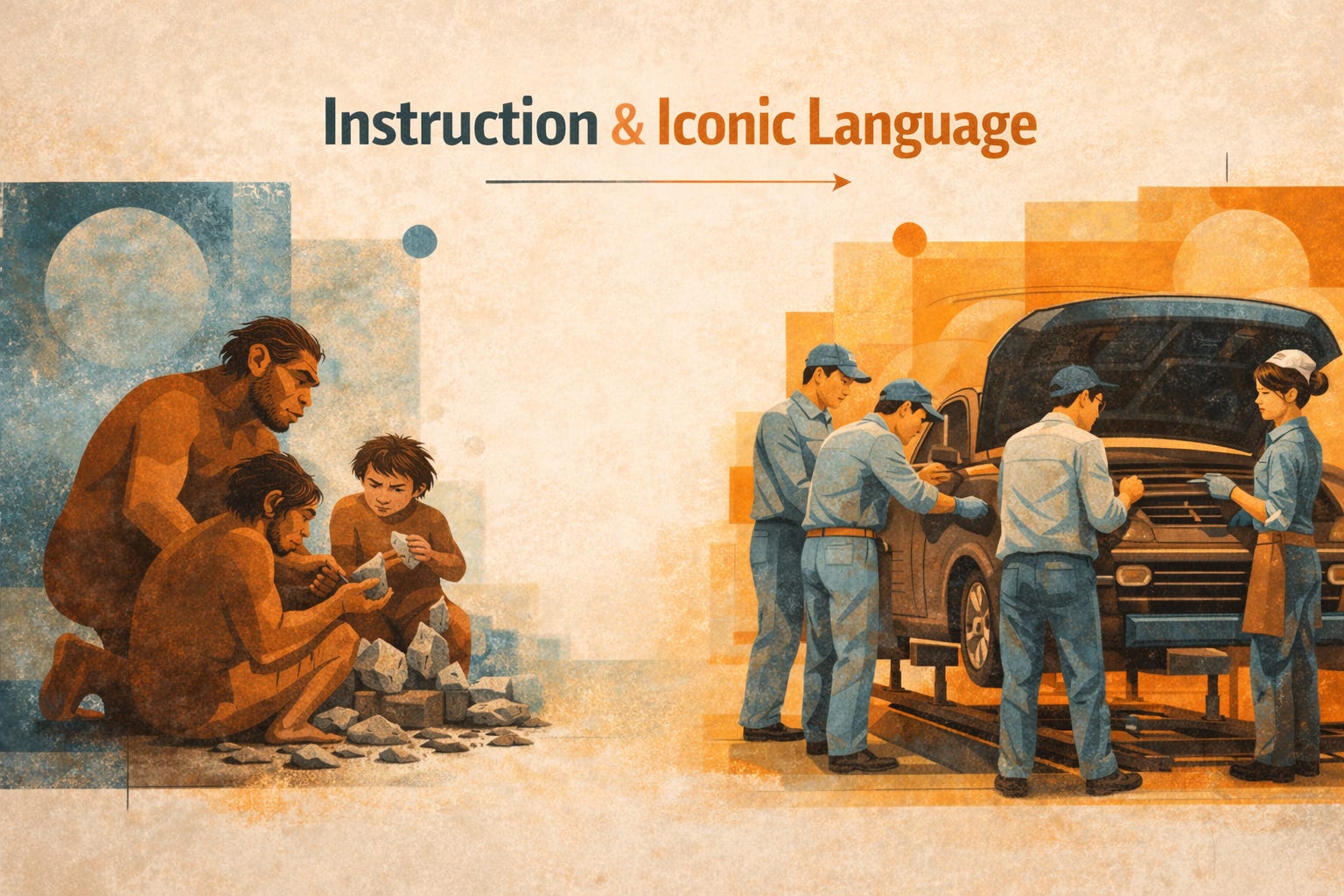
This post has great meaning for me. In the 1990s I was was an engineer at Honeywell working on control systems for jet engines. I remember participating in team-based training that quite literally opened my young mind to the challenges and benefits of good teamwork.
We’ll open with a story from Japan in the 1950s. Many of you may be familiar with Toyota’s impressive growth and quality innovations of the late 20th century.
This is the story of how a simple icon - the andon cord - became a powerful key to quality and growth.
Taiichi Ohno was a mid-level engineer inside a struggling Toyota company. Post-war Japan was economically shattered. Toyota had endured a devastating labor strike, its president had resigned, and production lagged far behind the USA automakers in Detroit.
Ohno visited American factories at the time, and noticed that stopping the assembly line was unthinkable. It required executive authority. It threatened careers and signaled failure. American business was structured so that responsibility for work flowed downward, while authority flowed upward.
Ohno inverted that structure.
He proposed that any frontline worker — even the newest hire — could halt production. All it required was something he called the andon cord. Pull it, and the line stopped. Machines froze. Supervisors rushed. Problems surfaced.
This andon cord did not build a car or fix a defect. By itself, it produced nothing. Its power was latent. It worked only if workers were trained, if managers responded without punishment, and if everyone shared the same definition of quality.
The cord redistributed authority for quality. It was no longer inspected for, at the end of the process, because it was owned at the source. That risky, countercultural shift became the foundation of a production system that would spread across Japan, then across the United States, and eventually across the world.
But the idea behind the Andon cord did not begin in 1950.
It began roughly 750,000 years ago.
Deep Origins
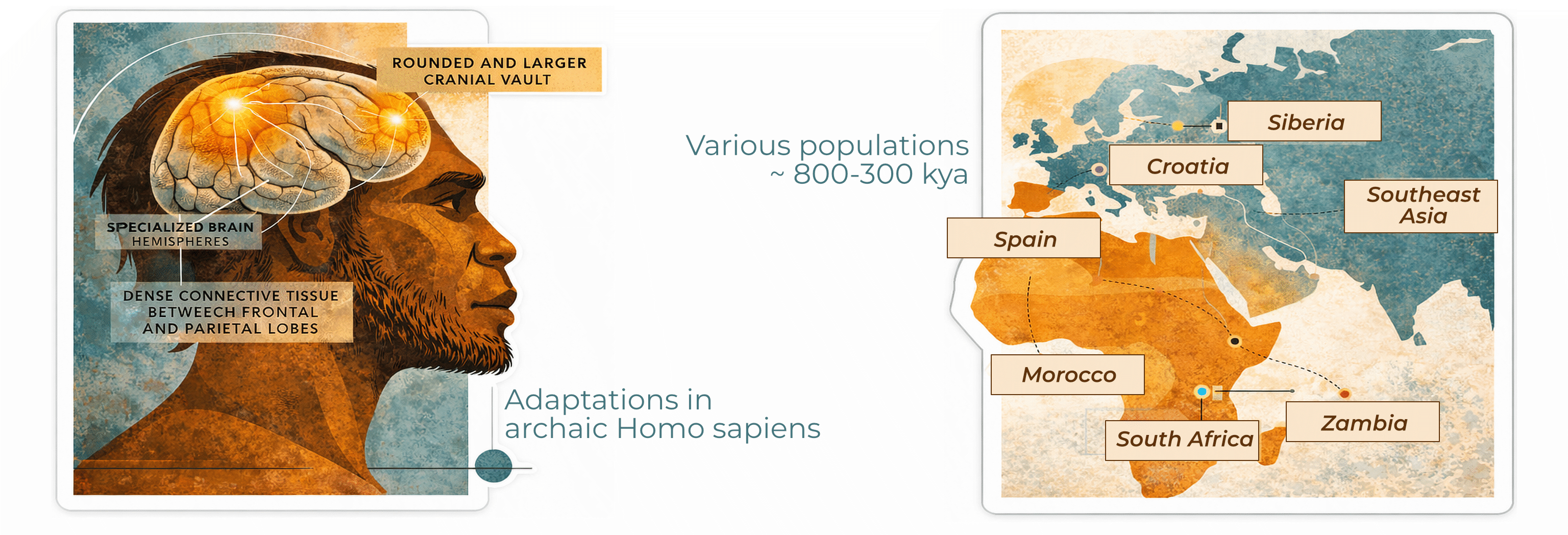
From roughly 800,000 to 300,000 years ago, ancestral humans expanded across Africa, Europe, and Asia. Multiple hominin groups coexisted and interbred. Morphology shifted. Tool complexity increased.
This period did not produce modern language overnight. There was no bright line that signaled BOOM - we had language.
Specific vocalizations, likely associated with crafts and tools, began to represent actions, objects, and shared meanings. Over many generations, these sounds became iconic words.
Our best understanding is that these iconic words stopped well short of our modern language. But iconic language unlocked tremendous advances.
Instruction became more deliberate. Human childhood lengthened. Cultural transmission deepened.
Please note that the label “archaic Homo sapiens” is used here as a behavioral descriptor of several populations, rather than a strict taxonomic boundary. Gene flow and cultural transmission crossed many ancestral peoples.
Neural Foundations
Compared to earlier hominins such as Homo erectus, these ancestors show larger brain volume, more rounded cranial vaults, increased integration between frontal and parietal regions, and greater hemispheric specialization.
These adaptations are strongly associated with abstract thinking and culture-based instruction.
Our executive control improved. Our impulse moderation strengthened. We could delay reaction, listen, and coordinate deliberately.
The brain did not simply enlarge. It became more connected. That connectivity allowed symbols — sounds, gestures, tools — to reliably carry meaning across many individuals and groups.
Iconic language and abstract thinking led to a clear adaptive advantage. Tools became more complex and useful. Populations bonded with a shared identity.
These neural foundations remain part of us today. A symbol like the andon cord carries meaning — but only if we have been trained to understand it.
Core Behaviors
Four behavioral shifts characterize this period, and remain key to transformative change at a group or workplace level.
Instruction. Humans became increasingly capable of teaching one another.
Knowledge more easily passed between groups and to the next generation. Longer childhood meant longer dependency and group investment.
Deliberation. Improved executive control allowed individuals and groups to pause and discuss options before acting. Instruction works best when people can hear, interpret, and respond intentionally.
Innovation. Toolmaking became more refined, as planning horizons extended, and mental representation expanded. One craft led to another. Communities borrowed successful practices from neighboring cultures.
Knowledge accumulated over generations, leading to tools, methods, and technologies that no individual could have created alone.
Shared Identity. Words and icons were shared, and marked the identity of groups and communities. Cultural boundaries and alliances expanded.
In the Modern Workplace
The andon cord is an iconic device that illustrates the core adaptations from long ago.
Toyota’s vocabulary — kaizen, gemba, kanban, andon — spread globally.
These iconic words were cognitive tools that encoded behaviors and shaped perception. As the language traveled, so did the system. Factories across continents could reproduce the same coordination because they shared the same symbolic framework.
This was cultural transmission at scale.
Modern organizations function the same way. A shared language and training builds a cultural identity across teams, customers, suppliers, and partners.
The Foundation Layer
The development of language matured gradually across hundreds of thousands of years. As represented on the Working Origins timeline, early vocalizations were certainly present before 800 kya, in ancestral homo Erectus populations.
Language continued to enrich and develop after the 300 kya marker, in early and modern homo Sapiens.
There was no sudden breakthrough, no singular invention. But as language developed, cultural change accelerated. Knowledge moved across generations more reliably, skills could be transmitted without direct imitation, and innovation began to compound.

As described by the Working Origins timeline, the marker “Instruct with language” builds upon earlier behaviors represented in the timeline sequence: emotions and drives, social learning, and trust and trade.
Takeaways
Three takeaways apply to our modern business teams.
First, instruction and training must be a priority for workplace teams. Each team member be personally committed. This builds a strong and shared culture.
Second, common language and cultural values have a bonding influence on a business ecosystem of customers, suppliers, and partners. Great brands like Apple, Nike, Mercedes-Benz, Google, and FedEx are built this way.
Third, building cultural depth requires time and investment by executives. Organizations that prioritize the necessary training and instruction consistently outperform those that don’t.
In the next post, we’ll jump forward along the Working Origins timeline to the agile cultures marker — which describes the adaptations that powered the great out-of-Africa expansions.
Until then, remember the Working Origins motto:
Working together well is the most human thing we ever do.
For more information on this post, see the Working Origins Library and these recommendations:
The Language Puzzle (2024) by Steven Mithen, a careful and engaging account of how language emerged across deep human time.
The Language Instinct (1997) by Steven Pinker, a foundational work on the biological basis of language.
The Selfish Gene (1976) by Richard Dawkins, which frames how traits and behaviors persist across generations.
Additional perspectives help round out the modern view.
The Singing Neanderthals (2005), also by Steven Mithen, proposes a “musilanguage” stage preceding fully symbolic speech.
From Hand to Mouth (2006) by Michael C. Corballis argues for gestural origins of language.
The Prehistory of the Mind (1996), also by Steven Mithen, remains influential in framing the emergence of cognitive fluidity.
The Symbolic Species (1997) by Terrence Deacon links brain evolution to symbolic capacity.
Language Evolution (2010) by W. Tecumseh Fitch offers a comprehensive synthesis across disciplines.
The widely cited paper The Faculty of Language (2002) by Noam Chomsky, Marc Hauser, and Fitch distinguishes core language capacity from broader cognitive systems.
Finally, genetic work on FOXP2, associated with Svante Pääbo, provides important evidence linking both Neanderthals and modern humans to shared speech-related capabilities.