

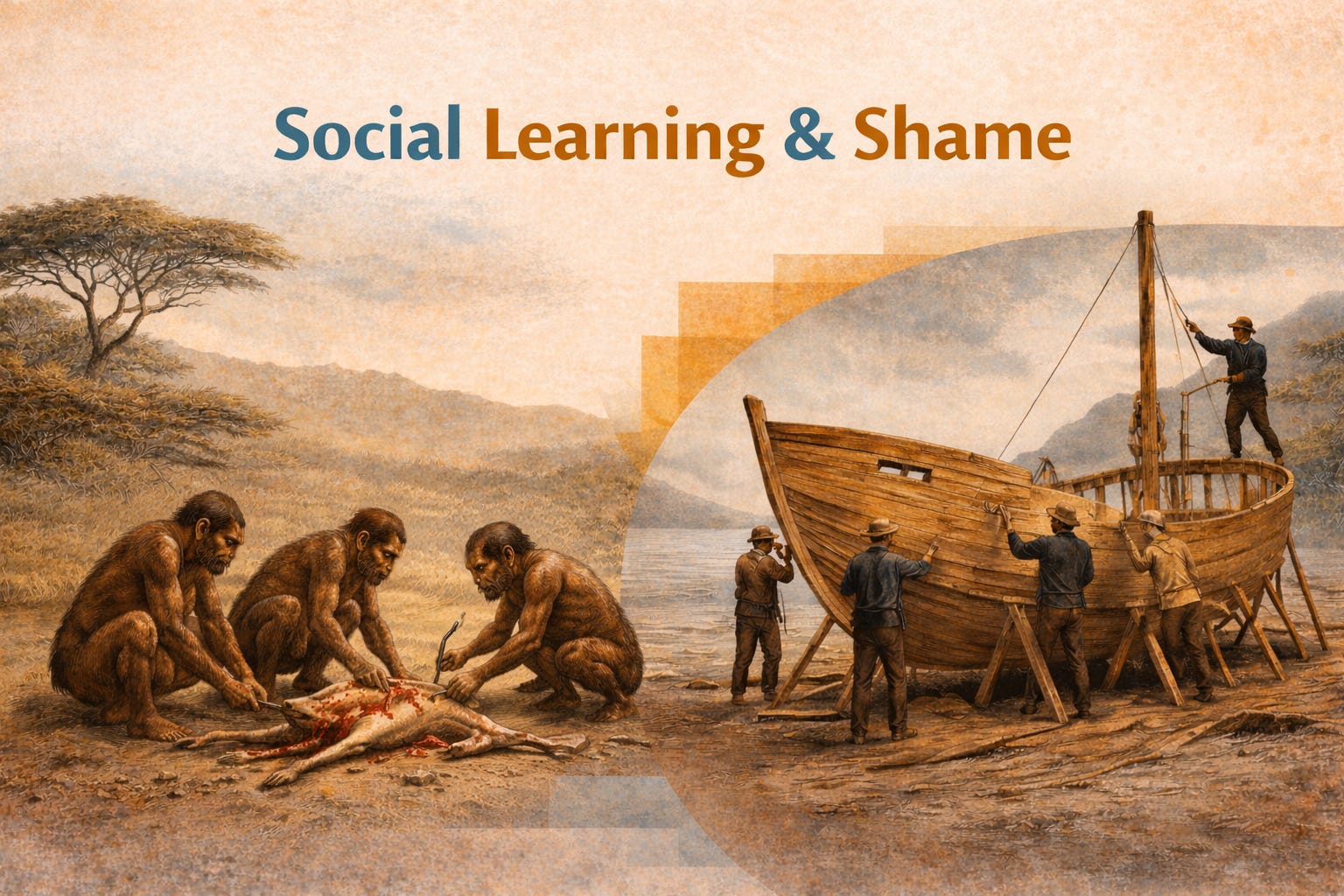
Roughly 150 years ago, two groups of castaways were stranded on the same sub-antarctic island for more than a year and did not discover each other.
One group essentially rescued themselves, and all survived. The other group expressed the worst of human impulses, and a remnant few were saved by blind luck.
The two stories reveal a great deal about leadership.
“We should draw lots to see who should be killed and eaten first,” whispered the boatswain to the other officers of the Invercauld. The 888-ton sailing vessel now lay dashed to pieces along the cliffs of the northwest Auckland Islands, a miserably cold place in the sub-Antarctic ocean, later described as the “Jaws of Hell.”
It was May of 1864, four days since the wreck of the Invercauld. Almost all of the eighteen survivors of the 25-man crew had passed those first days in stunned inactivity, clinging to rock ledges and narrow outcroppings above the surf. Captain George Dalgarno and his officers had brought nothing from the wreck—not even proper boots—leaving the men exposed to cold, hunger, and the pounding sea.
Seaman Robert Holding had not spent those days waiting. The son of an English gamekeeper, and seasoned by years prospecting alone in the Australian outback, he began at once to assess the land for survival. On the first day, he found a way up the cliffs to the grassy heights above, where gentler slopes led down toward inlets that might offer shellfish, fresh water, and shelter.
He climbed back down the cliffs and urged the others to follow. With loud complaints, they did—up to the heights and then down the grassy slopes to a sandy beach. He gathered shellfish, built a fire, and even killed and roasted a young seal, which the officers and crew eagerly devoured.
But as the days passed, he watched the officers withdraw again—silent, inactive, issuing only occasional commands for firewood or water.
It was then, while serving them, that Holding overheard the discussion of drawing lots.
That was enough. Holding now knew he could not depend on the officers for his survival.
Unknown to them, another shipwreck had already stranded five men on the southern end of the same island in the Auckland Islands archipelago.
On January 3, 1864, the schooner Grafton was driven ashore by a violent storm. Among the crew was François Raynal, the first officer, already weakened by illness when the ship struck. He was thrown ashore with four others onto that cold, sub-Antarctic shore—more than 200 miles south of New Zealand.
Raynal later wrote that he expected to die. But what followed was something very different.
Under the steady leadership of Captain Thomas Musgrave—and with Raynal as his closest partner—the five men organized themselves for survival. They established shelter, hunted and rationed food, and learned through trial how to prevent scurvy using local plants.
They assigned roles and rotated responsibilities to meet the needs of the group.
They also taught one another. In the evenings, they held lessons in mathematics, language, and reading. The crew—French, Swedish, English, and Portuguese—became, in effect, a small society.
Raynal, nursed back to health by the others, became indispensable. Using salvaged materials, he helped design and build a forge, with working bellows made from seal skins. From that forge, he produced the tools—nails, augers, fittings—that made a remarkable rescue possible.
After eighteen months, with no rescue in sight, the five men had built a 17-foot decked boat from the wreckage of the Grafton. They then sailed it across 200 nautical miles of open ocean to New Zealand.
They had built and executed their own means of rescue.
In stark contrast, Captain George Dalgarno and the officers of the Invercauld maintained a rigid separation between themselves and the crew. As later described by Holding, there was no effort to plan, assess, or organize the group toward survival.
Returning from one scouting trip, Holding saw officer Mahoney directing the two cabin boys, Liddle and Lansfield, to repeatedly fetch water and dig for roots. Mahoney never left his place by the fire. He ate and drank without sharing.
When Holding returned again, the scene had changed. Mahoney was now wearing the boys’ clothing over his own. The two cabin boys lay dead.
Mahoney ordered Holding to fetch him more roots. Holding refused. Mahoney then opened his jackknife and threatened him. Bending down, Holding picked up a stone and answered, “I’m too old a hand to be cowed by an Irish New York bully.” Mahoney paused, then lay back on his stretcher by the fire.
Meanwhile, Holding continued to range outward in search of seals, birds, eggs, and shellfish. Over the course of several months, he urged the others to move as each food source was exhausted around their camp. During one of these moves, as he coaxed the remaining group toward a new location with fresh supplies, officer Mahoney refused to go. His lifeless body was later found beside the cold remains of the fire.
At night, Holding slept apart from the officers, but returned to guide them when he could.
On May 22, 1865, the Spanish ship Julian rescued just three survivors of the Invercauld: Robert Holding, Captain George Dalgarno, and first officer Andrew Smith. Twenty-two others had died over the twelve months spent on Auckland Island.
These two groups of men had been stranded on the same island, during the same year of 1864. Neither group knew of the other until long after their rescue.
Five men, working together, built structure, sound plans, and a deep care for one another. All five survived by engineering their own escape.
Twenty-five men, divided by hierarchy and neglect, failed to organize as a group. Only three survived—and only by chance.
Each of us carries the same human biology as these men.
So how do we end up behaving in such different ways?
And what does that mean for the teams we depend on today—especially the workplace teams that provide our livelihood?
The answers come from the start of our human story—nearly 3 million years ago.
Deep Origins
Between roughly 3 and 1.5 million years ago, our earliest human ancestors—such as Homo habilis—survived using Oldowan stone tools in East Africa. To our best understanding, these simple choppers and flakes were used to quickly scavenge meat from large prey animals such as gazelle or wildebeest.
H. habilis was slight of build, standing about four feet tall, and no match for the lions and hyenas that brought these animals down. With Oldowan tools, they could dash out to an abandoned kill and quickly hack off chunks of meat, cut sinew, and break bones. Strong, gripping hands then carried this food back to trees or sheltered areas—safely away from returning predators.
These tools became so central to survival that, over roughly 1.5 million years, H. habilis developed what we can describe as an Oldowan culture—marked by social learning, care for one another, shame, and non-verbal communication.
Without any formal language, young or newly accepted group members learned by observing and mimicking more experienced adults. Over time, they acquired the skills to locate raw materials and to make, carry, and use stone tools. This form of social learning allowed Oldowan practices to persist across generations and to spread between groups.
Group cohesion was reinforced through acts of care—nurturing the wounded, protecting the vulnerable, and sharing food. These were not optional behaviors; they were essential to group survival.
Shame emerged as a fast, adaptive mechanism to keep individuals aligned with the group under constant pressure. It is the internal social signal that arises when an individual senses they are out of step with group expectations—and at risk of rejection or loss of standing.
Non-verbal social signals, inherited from earlier primate ancestors, were refined and reinforced during this time—and remain with us today. Open hands and arms signaled a non-threatening approach. The open-mouth grin and vocalizations evolved into our smiles and laughter. Averted gaze and lowered posture signaled submission and helped prevent conflict.
These tightly bonded groups became highly resilient over countless generations, capable of enduring the persistent challenges of territorial conflict, drought, famine, and disease.
Early researchers such as Louis, Mary, and Jonathan Leakey identified Homo habilis and the Oldowan tool tradition. Later researchers, including John Napier and Phillip Tobias, described the hand and cranial features associated with tool use, while more recent work—such as that of Robin Dunbar—has helped frame the relationship between brain development, social behavior, and group size. Dunbar’s number, often cited at around 150 individuals, reflects a rough upper limit on the number of stable social relationships humans can maintain - even today.
Biological Foundations
Through roughly 1.5 million years of Oldowan-era life, early humans underwent meaningful biological changes that shaped how they lived and survived together. These were not sudden transformations, but gradual shifts that improved group coordination, learning, and cohesion.
Brain size increased over this period, but more important than size alone was how the brain was reorganized. Regions associated with attention, social awareness, and decision-making became more developed.
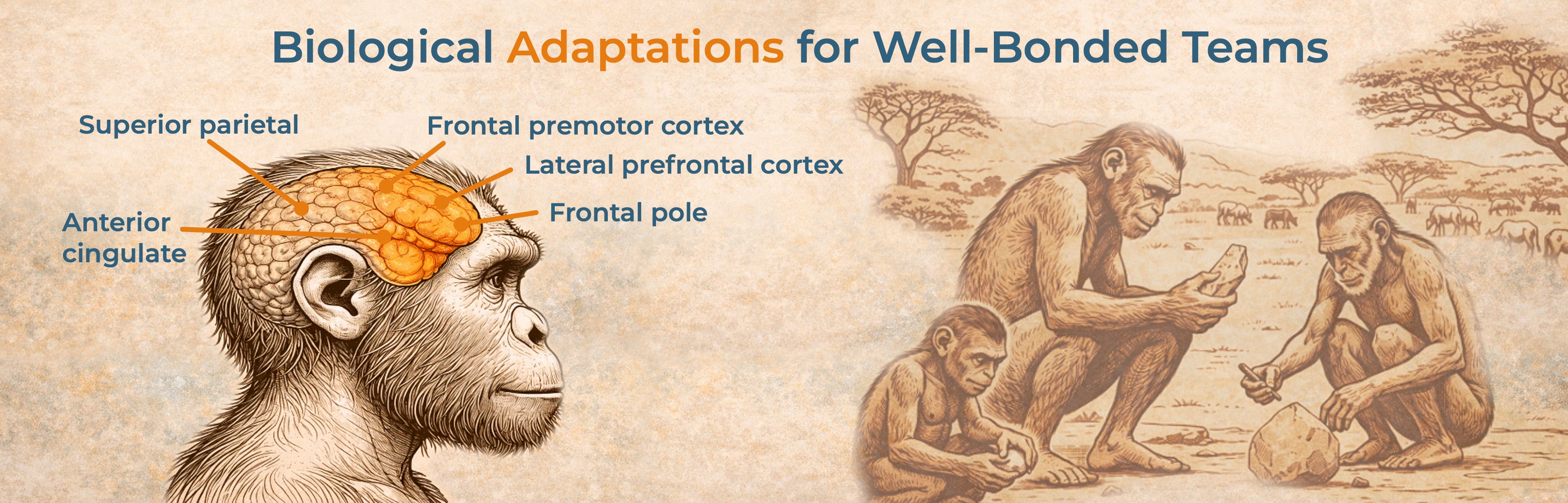
Connectivity within the brain also improved, allowing information to move more efficiently across regions.
These changes supported larger, more stable groups, reduced reactive aggression, and improved social learning and cultural transmission.
There is also evidence that specialized neurons, including von Economo neurons (VENs), became more prominent in regions such as the anterior cingulate and insula. These areas are associated with social awareness, error detection, and an internal sense of self in relation to others. While we should be cautious about projecting modern self-awareness too far back, these developments suggest an emerging capacity to recognize when one is out of step with the group—and to adjust accordingly.
These are the biological foundations of strongly bonded and successful groups.
Core Behaviors
Based on these biological foundations, three key behaviors define a well-bonded group.
The first is alignment to a successful survival strategy. All members of an H. habilis group were aligned around the use of Oldowan tools as essential to survival. Likewise, the Grafton crew adapted to their new environment and aligned to a clear strategy—including a 17-foot vessel for escape. In sharp contrast, the Invercauld crew and officers were not aligned to any shared survival strategy. The officers maintained a separate and higher status, with no clear plan beyond outlasting the crew. This failed both the environmental challenges of the Auckland Islands and the most basic requirement of a well-bonded group.
The second behavior is social learning. Every member of a well-bonded group must invest in and reinforce the group’s culture. A young H. habilis would observe and mimic the patterns of more experienced adults. The Grafton crew, led by their officers, met each evening to plan, teach, and learn.
The Invercauld officers, by contrast, refused to adapt, align with, or even value the seasoned experience of Robert Holding. After his rescue, Captain Dalgarno pressured Holding to remain silent about what had occurred on the island. His official report offered only a brief and generalized account of “overcoming great challenges,” making no mention of Holding or his life-saving actions.
The third characteristic of well-bonded groups is strong cohesion, reinforced through genuine care and shame. This goes beyond obligation. Group members willingly share food, care for one another, and moderate their own needs in service of the group. They feel a deep sense of shame when they violate group expectations—or even when they sense that others may see them as doing so.
Captain Thomas Musgrave showed this kind of care even after his own rescue. The limitations of the 17-foot vessel prevented all five men from leaving the island at once; two had to remain behind. After reaching New Zealand, Musgrave devoted all of his effort to organizing a return rescue. His health was failing, and he had no financial resources of his own. He went door to door, seeking support from homes and businesses. His persistence paid off. Five weeks later, he returned to the Auckland Islands and rescued the remaining two members of his crew.
Foundation Layers
Looking across the Working Origins timeline, Social Learning moderates the earlier drives and emotions that we inherited from our primate ancestors. The next marker, Trust & Trade, expands these behaviors beyond the immediate group into broader networks of cooperation.

In the Modern Workplace
Jeff Bezos popularized the phrase “two-pizza teams,” referring to small, manageable teams at Amazon that can get meaningful work done quickly. These teams are intentionally kept small—well within the limits of what individuals can comfortably manage and relate to—and are aligned around a clear objective or strategy. Shared meals, daily planning, and learning together naturally reinforce the biological foundations of well-bonded teams. Expressions of care, feelings of shame, and personal commitment emerge as natural outcomes.
Modern military organizations are built around small, tightly bonded units. Military leaders recognize that trust, discipline, and mutual commitment grow most naturally in groups where each person is known personally and shares hardship, challenge, and success with others. They become well-bonded teams whose members willingly place the success of the group, and often one another's lives, above their own immediate interests.
Takeaways
Each of us in today’s workplace hopes to be part of a well-bonded and highly successful team.
We can apply a few clear guidelines.
Success strategy. A clear picture of success should be visible to everyone. It is surprising how often team members cannot describe what success looks like—let alone how it connects to the broader business strategy. Each person should feel a sense of ownership in that outcome.
Social learning. Strong teams share a culture of expectations and performance. Written policies may exist, but visible patterns matter most. Patterns of work, training, planning, communication, and response should all align to the success strategy. These visible patterns are what build culture.
Shame and care. When a team shares a common strategy and culture, members naturally feel accountable to one another. They experience shame when they fall short of group expectations, and genuine care when others need help.
Non-verbal signals. More than a million years before primitive language, the Oldowan culture included non-verbal signals. Today, the influence of non-verbal signals can be difficult to measure, but it is always present. Modern teams are physically distributed, working through video, audio, and shared systems. Even so, non-verbal signals remain essential—just as they have for millions of years. Eye contact, gestures, a smile or laugh, a pause, a handshake, shared time, shared space. The strongest teams make deliberate use of these important signals, even when separated by distance.
Good teams are the bedrock on which strong business networks are built.
Well-bonded teams reflect a simple truth at the core of Working Origins:
Working together well is the most human thing we ever do.
For more information on this post, see the Working Origins Library and these recommendations…
Island of the Lost by Joan Druett — for the story of Auckland Island castaways and the role of group cohesion in survival.
Stone Tools and the Evolution of Human Cognition by April Nowell and Iain Davidson — for the relationship between tool use and biological adaptation.
On Human Nature by Edward O. Wilson — for the co-evolution of culture and biology.
The Making of Mankind by Richard Leakey — for a grounded account of early Homo, including Homo habilis.
How Many Friends Does One Person Need? by Robin Dunbar — for insight into the social limits and structures that shape human groups.