

A good David-vs-Goliath story can come in many forms. A small business startup, sports team, musical artist, or an independent movie producer can enjoy sudden or surprising success.
Every generation, some small teams consistently outperform the bigger and dominant ones.
The Russo-Turkish War is that kind of story, and offers key lessons for how we each may perform better than expected.
In the autumn of 1789, an Ottoman army of well over one hundred thousand men advanced into what is now Romania. Waiting for them near the Rymnik River was an allied Austrian and Russian force of less than twenty thousand. If the Ottomans were to win this battle, they could advance far into Central Europe.
Their commanders were Prince Josias of Saxe-Coburg and the Russian General Alexander Suvorov. They understood the odds as well as anyone, and also knew they would get no help from larger European powers like France or England. These great powers of Europe were distracted by their own concerns, and France itself stood on the threshold of revolution.
The Ottoman commanders had every reason for confidence. Their empire had dominated southeastern Europe for centuries, and had controlled most of the world’s most valuable trade routes. The Ottoman empire fielded one of the largest armies on Earth. At its heart stood the Janissaries, a professional corps whose discipline and battlefield reputation had become legendary. For generations, European rulers had measured their own armies against the standard the Janissaries had established.
While Ottoman victory looked certain, by the end of the campaign, the smaller allied force had shattered the Ottoman army.
How could this have happened?
Military historians have long admired Suvorov’s leadership, but leadership alone does not explain the result. The Austro-Russian army did not possess a miraculous new weapon, nor did it prevail through lucky chance or wartime tactic. Its real advantage was earned before the war started. It had spent decades learning and adopting better ways of organizing, training, supplying, and coordinating its forces. Infantry, cavalry, artillery, logistics, engineering, and command increasingly operated as parts of a single system. Hundreds of refinements, many borrowed from other armies, had been gained through hard battlefield experience. These small but steady improvements had accumulated into a military organization capable of defeating an opponent many times its size.
Ironically, the Ottoman Empire had once been one of history’s greatest examples of exactly that kind of learning. During its rise, Ottoman rulers borrowed freely from the civilizations around them. They incorporated Byzantine administration, Persian statecraft, Arab scholarship, European artillery, and innovations from countless neighboring cultures. Even the Janissaries themselves represented a bold organizational innovation, solving problems of loyalty and professionalism that had frustrated Ottoman rulers for centuries.
Success, however, can produce an unexpected hazard, as organizations naturally preserve successful practices. Over time those practices become traditions, traditions become institutions, and institutions begin protecting themselves.
By the eighteenth century, many Ottoman reformers recognized that European armies were changing. They sought new training methods, new command structures, and new military schools. Yet those reforms repeatedly collided with powerful interests that were determined to preserve the existing order. The Janissaries, once an engine of innovation, had become the strongest barrier to change.
The lessons extends far beyond military history, applies to all organizations—including the Janissaries themselves.
First, organizations begin to fail when they become unwilling—or unable—to adopt new ideas.
Second, great competitive advantage seldom comes from a single breakthrough. Organizational strength, and personal skill, is more often built on a steady accumulation of practical improvements, tested by experience, and willingly adopted as change.
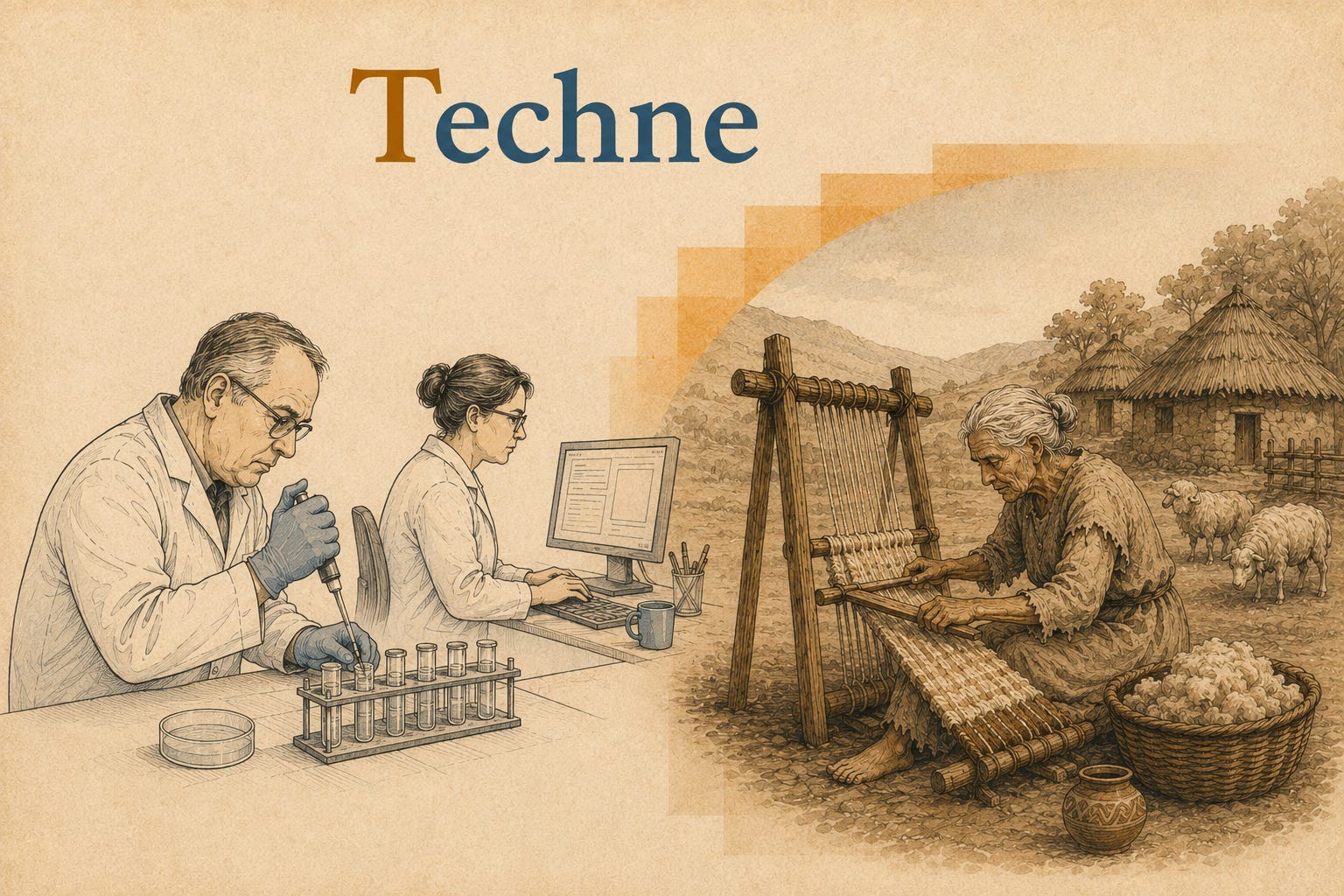
More than two thousand years before the battle of Rymnik, the ancient Greeks gave the accumulation of valuable skills a name: techne—the practical knowledge acquired through skill, experience, and craft.
Yet techne was far older than the Greeks.
Deep Origins
Between roughly twelve and six thousand years ago, Neolithic societies began the fastest cultural transformation up to that time in our human history. The transformation happened across several parts of the world, and led to many new technological innovations.

The transformation included taming of animals such as dogs, sheep, goats, cattle, llamas, pigs, and chickens.
At roughly the same time, the domestication of plants included wheat, barley, rice, millet, maize (corn), beans, and potatoes.
Key technologies were created such as pottery, weaving, sailing, the wheel, irrigation, and mud-brick architecture.
Hunter-gatherer bands began cultivating crops, herding animals, and settling in permanent villages. Populations grew, and food surpluses appeared. Families remained in one place long enough to build homes, workshops, storage facilities, and eventually towns.
A settled farming community allowed people to specialize. One family became known for pottery, another for weaving, another for toolmaking, another for brewing or carpentry. Skills could now be practiced every day, refined over decades, taught to apprentices, and improved from one generation to the next.
Trade accelerated this process even further. Goods traveled between villages, but so did ideas. A better kiln, a stronger loom, a more effective plow, a new method of preserving food, or a different way of building a shelter could spread across entire regions. Practical knowledge accumulated through observation and experience.
The accumulation of practical knowledge was what the ancient Greeks would call techne.
From a cultural perspective, techne behaviors were taught, encouraged, and became key to thriving communities. These increasingly adaptive skills dramatically changed the way humans lived during the neolithic period. Of course, such change continues to this very day.
Adaptation
The Neolithic period of roughly 12,000 to 6,000 years ago was a time of rapidly changing culture. Our human biology was changing as well.
Living in larger, permanent communities exposed populations to unfamiliar diseases carried by both humans and domesticated animals. Over many generations, natural selection favored genetic variants for disease resistance. Differences in diet encouraged adaptations affecting metabolism and digestion. In some populations, traits such as adult lactose tolerance became increasingly common. In others, long-term exposure to different environments influenced skin pigmentation, hair and eye color, or even facial morphology.
These adaptations were accompanied by subtler behavioral changes.
Many researchers describe a process of human self-domestication. Compared with our distant ancestors, people became less reactive, more cooperative, and better able to live in increasingly complex social groups. Longer childhoods provided more time for observation, imitation, and learning. As societies became more specialized, individuals devoted years rather than months to mastering particular crafts.
Throughout the Neolithic and into our modern times, new crafts and trades created selective pressures for holding focused attention, grasping complex concepts, or retaining abstract instructions.
Foundations of Techne
The neolithic transition suggests three foundations of techne.
First, innovation emerges from a cross-section of cultures. Throughout the Neolithic, the greatest advances appeared where people, materials, and ideas came together. Trade routes exchanged more than goods; they exchanged techniques, experiments, and practical solutions.
Second, techne grows through the accumulation of practical skills rather than a single moment of genius. The Greeks that first described techne recognized that a variety of skills must be mastered to produce excellent works. Testimony to Greek techne is found in their impressive buildings, statuary, agriculture, writing system, trading industry, and seafaring culture. The Greeks freely adopted skills and crafts from other cultures. As an example, the Greek alphabet was adapted from the Phoenician writing system, reflecting how practical knowledge and innovation often spread through trade and cultural exchange rather than arising in isolation.
Third, meaningful techne requires time. By the end of the Neolithic, settled societies invested years in apprenticeships because important skills cannot be transferred instantly. Modern organizations often underestimate this reality. Trust, judgment, craftsmanship, leadership, and technical excellence all compound through repeated practice under the guidance of experienced mentors.
These are the most enduring lessons of techne from the Neolithic. Techne emerged from 1) cross-cultural exchange, 2) willing adaptation to new improvements, and 3) steady commitment to skill development over time.
Foundation Layers
Looking across the Working Origins timeline, the Techne marker reflects further moderation of much earlier behaviors associated with Agile Cultures, Myth & Mediation, and Instruction & Iconic Language.
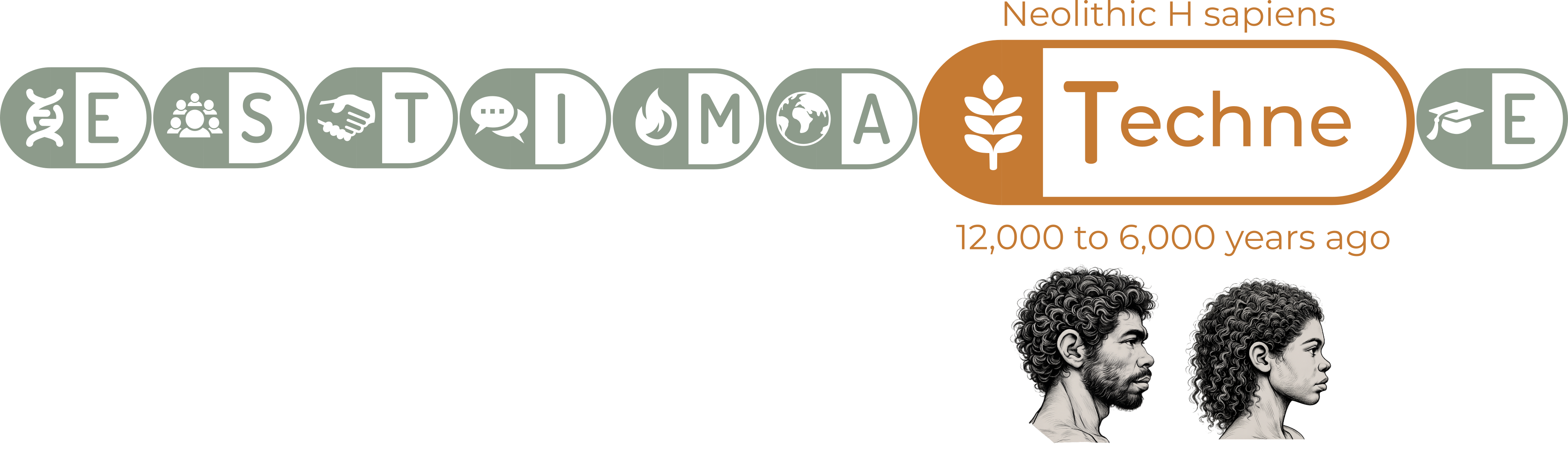
The next and last marker is Education, which describes further and on-going adaptation to modern norms and skills.
Today’s Workplace
In 2020, biochemist Jennifer Doudna shared the Nobel Prize for a breakthrough that is changing medicine, agriculture, and biotechnology. The technique, known as CRISPR gene editing, allows scientists to make remarkably precise changes to DNA.
Yet the breakthrough did not begin with a flash of inspiration. It emerged from decades of accumulated discoveries by researchers around the world. In 1987 scientists first noticed unusual repeating DNA sequences in bacteria. Around 2005, others realized these sequences formed part of a bacterial defense system against invading viruses. Then in 2012, Doudna and her collaborator, Emmanuelle Charpentier, recognized that this ancient bacterial mechanism could be adapted into a practical tool for editing genes.
Common bacteria (Streptococcus pyogenes and Escherichia coli) could be isolated and the molecular machinery directed to produce Cas9 enzymes. When mixed with guide RNA and a DNA molecule with a matching sequence, the Cas9 enzyme recognizes a target and precisely replaces a DNA sequence.
The CRISPR story echoes the origins of techne as a collaboration across countries and cultures. Innovation came on top of countless earlier discoveries.
Cautionary Tale
There is a cautionary lesson in the role played by the Janissaries at the Battle of Rymnik of 1789. By the early 1700s, they had reverted to a political pressure group rather than an elite military force. Membership was inherited or purchased for a fee, and was no longer based on training or fighting skill.
Following the dismal results of Rymnik, Sultan Selim III attempted to modernize the army with a European-style force (the Nizam-ı Cedid, or “New Order”). The Janissaries triggered a revolt and forced him from the throne.
After Selim III was deposed, his supporters attempted to restore him. The Janissaries responded by murdering him inside his own palace in 1808 before he could be rescued.
Following the murder of Selim III, his Grand Vizier Alemdar attempted to restore military reform. Roughly a thousand Janissaries surrounded his residence with the intention of killing him. Trapped and realizing escape was impossible, Alemdar ignited the building's gunpowder magazine, killing himself and an estimated 400 of the attacking Janissaries in the explosion.
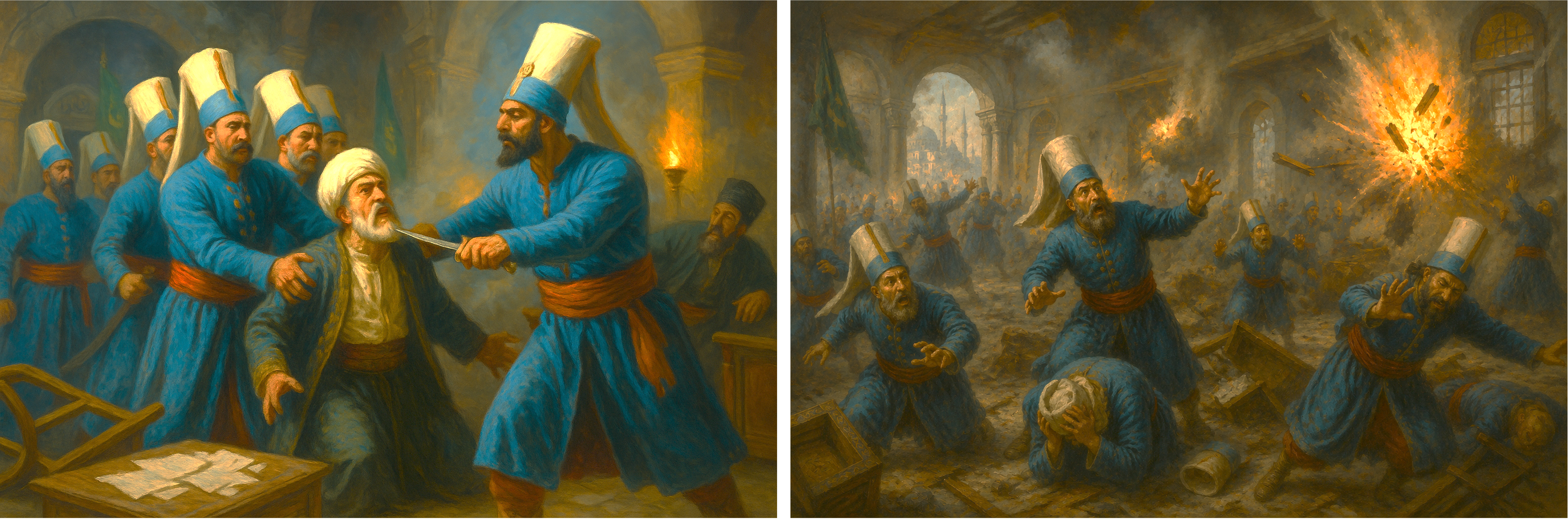
In what is now called the “Auspicious Incident” of 1826 everything finally changed for the Janissaries.
Sultan Mahmud II saw that reform was impossible while the Janissaries existed, and set a plan in motion. He deliberately provoked a confrontation and Janissary revolt. Mahmud II had secretly organized loyal artillery forces who began bombarding the Janissary barracks in Istanbul. Thousands were killed or executed, the corps was abolished, and all of its property confiscated.
Few organizations in history have traveled such a dramatic and historic arc. For hundreds of years they were widely admired as an elite and loyal military force. They ended with corruption and such resistance to change that their own government chose to annihilate them.
Takeaways
Techne brings two lessons to mind. One for business leaders. The second for people entering or re-entering the workforce.
The first takeaway is that, like techne, a great business is a collection of skills, processes, and other bits gained over time. Identifying a few bits to add or modify allows a pivotal change while leaving the business core intact.
Netflix pivoted from distributing physical DVDs to streaming in the mid-2000s.
Domino’s Pizza reformulated the crust, sauce, and cheese around 2009, and publicly admitted the pizza had not been good enough.
Starbucks made digital ordering a core capability in 2021, when COVID caused a severe disruption.
The second takeaway addresses the challenges of finding a good fit in today’s changing workplace. Techne offers the lessons of practical skill and invested time.
I am very moved by stories of the challenging job market. However, practical skills are still rewarded.
Leaving professional degrees aside, there are very well-paid jobs available for welders, HVAC technicians, electricians, machinists, plumbers, chefs, dental hygienists, or ERP/CRM administrators. Entry-level qualifications can generally be earned with a year of training or instruction.
Every one of these occupations combines instruction, mentorship, repeated practice, and increasing responsibility.
These are the essential qualities of Techne as seen today, and which align well with the Working Origins motto.
Working together well is the most human thing we ever do.
For more information on this post, see the Working Origins Library and these recommendations…
The Evolution of Paleolithic Technologies by Steven L. Kuhn (2021) — for how shifting tools and techniques reflect adaptable human behavior across changing environments.
Stone Tools and the Evolution of Human Cognition edited by April Nowell and Iain Davidson (2010) — for how the making and use of stone tools illuminate the evolution of human learning, planning, and skilled craftsmanship.
Code Breaker by Walter Isaacson (2021) — for more information on Jennifer Doudna and the CRISPR technique, and how scientific discovery, collaboration, and practical innovation continue to reshape human capabilities in the modern world.
Domesticated by Richard C. Francis (2015) — for how the domestication of plants, animals, and even humans transformed biology, behavior, and civilization.
Tamed by Alice Roberts (2017) — for an engaging account of how domestication reshaped both human societies and the species that evolved alongside us.