

This post briefly reviews the Working Origins timeline of eight key adaptations.

Each marker represents a set of biological and cultural adaptations that improved how we work together. Today, the biological adaptations remain encoded within us. However, not all teams develop the cultural conditions needed to unlock and express good workplace behaviors.
That is the leadership challenge addressed here in Working Origins.
The ESTIMATE acronym serves as a memory device to recall the eight marker labels.
Emotions, States & Drives
Our pre-human ancestors possessed the emotions, states, and drives that were well fit to the savannah of East Africa, and are the foundation of who we are today.
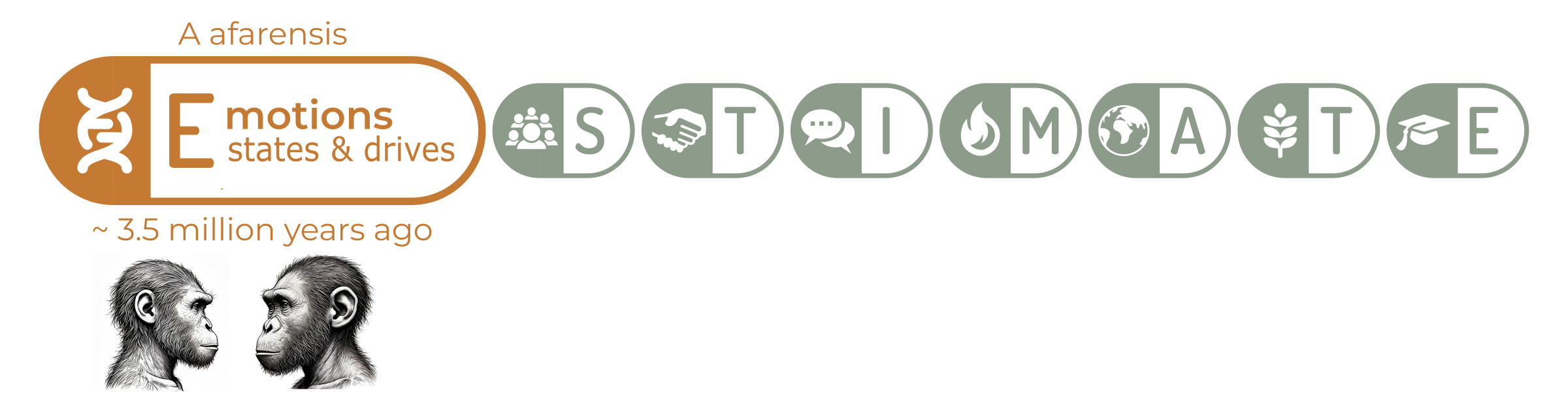
Australopithecus afarensis is the hominid commonly associated with this period of roughly 3.5 million years ago. A afarensis showed significant intelligence and social group behaviors.
Social Learning
Most experts describe Homo habilis as our first human ancestor, with clear evidence of populations in the East African Savannah from 3 to 1.5 million years ago.
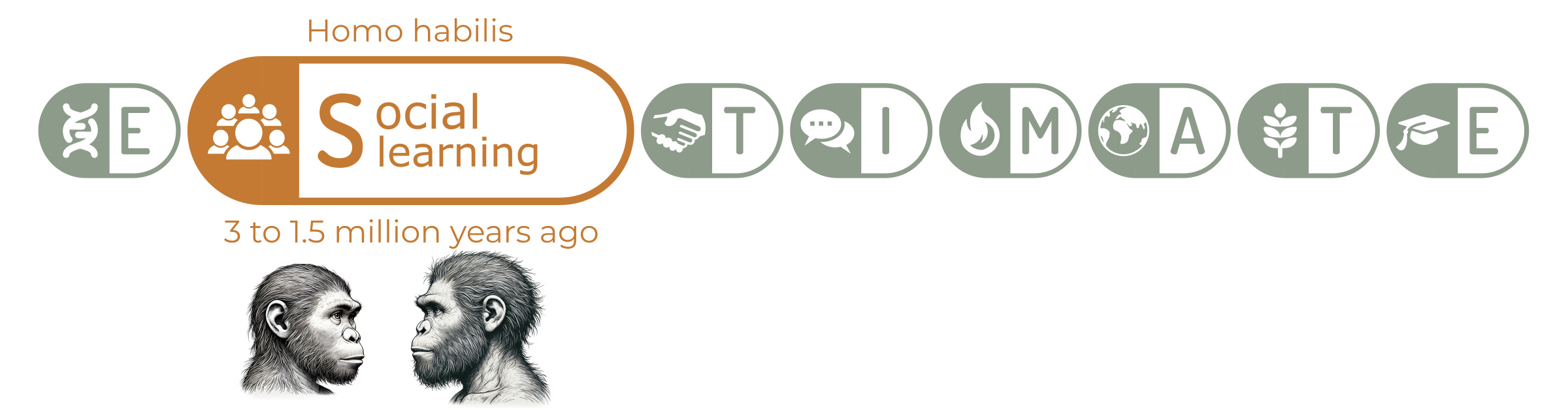
Ancestors such as H. habilis established an enduring Oldowan stone-tool culture that could spread from one group to another and from one generation to the next. Associated behaviors include tool craft and use, social learning, and group bonding through care and shame.
Trust & Trade
Homo erectus populations spread widely across Africa, Asia, and Europe from about 1.5 million to 750 thousand years ago.

During this time, human ancestors began transporting and exchanging goods. Associated behaviors included self-identity, empathy, and theory of mind.
Instruct with Language
From 850 to 350 thousand years ago, several populations of interrelated ancestors lived across Africa, Europe, and Asia. Here they are described simply as archaic Homo sapiens.

This period saw the rise of several important behaviors, including the use of iconic language, longer childhood development, improved deliberation and executive control, innovation in toolmaking, and the emergence of shared identity across groups and communities.
Myth & Mediation
A number of human populations existed across Africa and Eurasia from 450 to 100 thousand years ago. In this timeline, they are described as early Homo sapiens.

This period is marked by the controlled use of fire, better mediation of impulsive reactions, the emergence of storytelling, and the earliest systems of myth and belief.
Agile Cultures
From 90,000 to 12,000 years ago, our ancestors spread from Africa to nearly all parts of the world. This marker describes them as diasporic Homo sapiens.

Behavioral expressions during this time included specialized tools and group roles, exploration and creativity, planning and improved episodic memory, and the sharing of abstract ideas across groups—including concepts of future places and times.
Techne
From roughly 15,000 to 2,500 years ago, neolithic Homo sapiens developed Techne. This is a little used word that precisely describes material intelligence. H sapiens domesticated most of the plants and animals that would become the foundation of civilization.
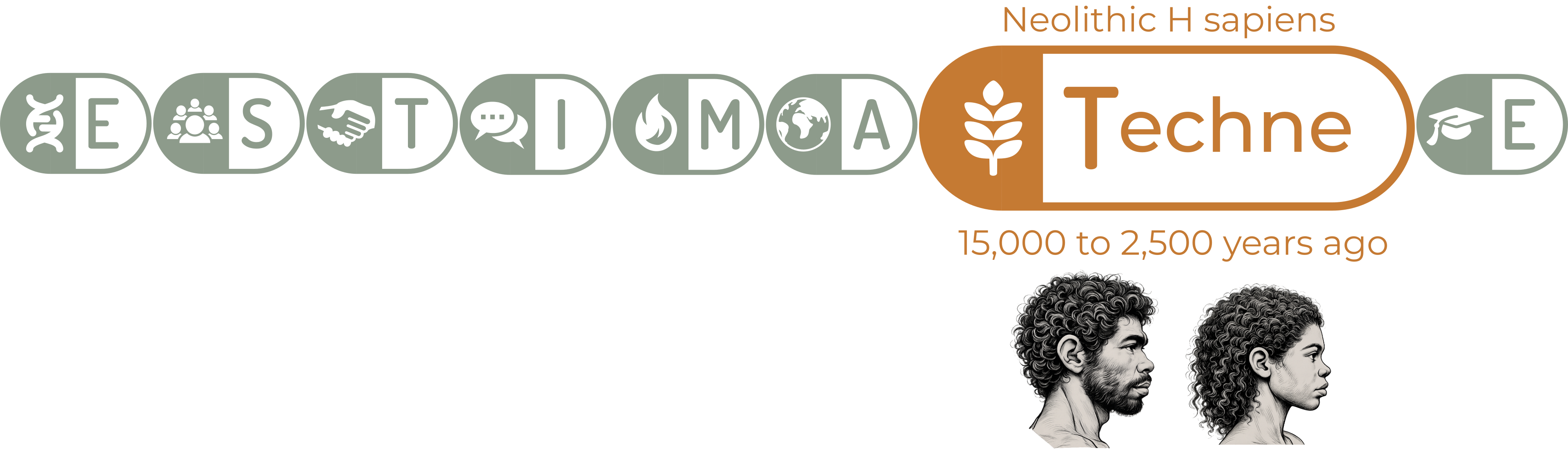
At the same time, neolithic H sapiens adapted to major changes in lifestyle and behavior. These included new technologies, village-based (sedentary) living, new diseases, specialized crafts, and expanded trading systems.
Education
Beginning around 5,500 years ago, the first civilizations of modern Homo sapiens emerged in Mesopotamia, the Nile River Valley, the Indus Valley, along the Yellow River, in Mesoamerica, and in the Andean region.

Writing was a common feature across these civilizations—if we broaden the definition to include all durable information systems. These included knotted cords, symbols, bone scripts, glyphs, and icons.
Some level of formalized education became necessary to participate in civilized society—enabling individuals to understand crafts, systems of exchange, labor roles, laws, and religious practices.
Writing and education enabled persistent and durable cultural transmission, across communities and many generations.