

Hello. This is Chris Gray. At the time of this writing, I live in East Greenwich, Rhode Island. My product development career has included work at Honeywell, Microtest, EMC, KVH, and Cogneti.
Alongside the technical work, I’ve kept a steady focus on a basic question of teamwork: Why do people work the way we do?
The Big Idea
Working Origins examines our human origins as best revealed by modern science. Eight key workplace behaviors, such as social learning and iconic language, are highlighted on a timeline.
We’ll look for the cultural foundations of each behavioral adaptation.
The big idea of Working Origins is pretty simple:
To encourage a key workplace behavior in modern teams, build its cultural foundation
Timeline Model
The Working Origins timeline shows eight cultural foundations that shaped how humans learned to work together. Each foundation encouraged important workplace behaviors that remain recognizable today.
Together, these markers form the acronym ESTIMATE:
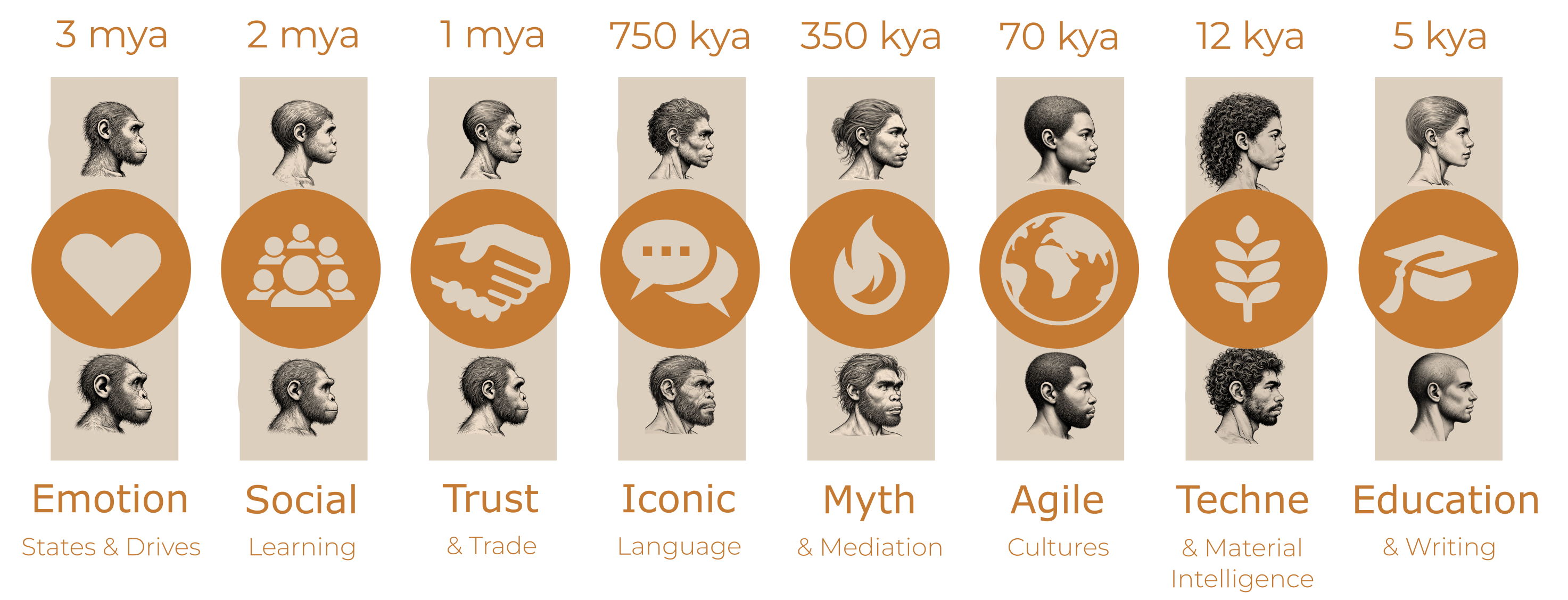
E — Emotions, states, and drives (~3 million years ago)
S — Social learning (~2 million years ago)
T — Trust and trade (~1 million years ago)
I — Instruction and language (~750 thousand years ago)
M — Myth and mediation (~350 thousand years ago)
A — Agile cultures (~70 thousand years ago)
T — Techne and material intelligence (~12 thousand years ago)
E — Education and writing (~5 thousand years ago)
Each marker identifies a cultural foundation together with the workplace behaviors it helped encourage.
Purpose
Working Origins has two objectives.
First, to make our human past easier to understand with a simple timeline model.
Second, to translate cultural insights into practical leadership for modern teams.
Audience
Working Origins is written for working people—across roles, industries, and levels of experience. This includes church groups, sports teams, gardening clubs, or businesses.
While there is a focus on the business workplace, the leadership lessons apply broadly.
Working Origins Motto
Each post ends with the Working Origins motto: Working together well is the most human thing we ever do.
This reminds us that working together has shaped human development from the very beginning. Roughly 3 million years ago, early humans used tools to make a better living. They passed the key skills to their children.
That is the beginning of culture, and in a very real sense, it is the beginning of the workplace.
Science
Working Origins draws from three primary fields of study.
Human biology, including genetics, cranial development, and paleoneurology, helps explain how our bodies and brains evolved over time.
Archaeology and related disciplines reveal how people lived—through tools, art, and material culture across time and place.
Behavioral sciences act as an interdisciplinary bridge—linking material culture (tools, symbols, skills) to inferred brain function and structure. These include cognitive archaeology, paleoneurology and developmental psychology. These researchers help us understand how culture shapes behavior—how we think, feel, and act.
Working Origins builds on these disciplines to explore how workplace culture can encourage the expression of important human behaviors.